- Barca-longa
- Barque
- Barquentine
- Bermuda rig
- Bermuda sloop
- Bilander
- Brig
- Brigantine
- Caravel
- Carrack
- Catamaran
- Catboat
- Clipper
- Dutch clipper
- Cog
- Corvette
- Cutter
- Dhow
- Dinghy
- East Indiaman
- Falkuša
- Felucca
- Fifie
- Fluyt
- Fore-and-aft rig
- Frigate
- Full rigged pinnace
- Full rigged ship
- Fusta
- Gaff rig
- Galeas
- Galleon
- Galiot
- Gunter rig
- Hermaphrodite brig
- Herring buss
- Hoy
- Jackass-barque
- Jangada
- Junk
- Ketch
- Koch
- Longship
- Lugger
- Man-of-war
- Mast aft rig
- Masula
- Mersey Flat
- Multihull
- Nao
- Nordland
- Norfolk punt
- Norfolk wherry
- Patache
- Pausik
- Pilot cutter
- Pink
- Pinnace (ship's boat)
- Pocket cruiser
- Polacca
- Pram
- Proa
- Razee
- Sailing barge
- Sailing hydrofoil
- Scow
- Schooner
- Ship of the line
- Sixareen
- Sgoth
- Shitik
- Sloop
- Sloop-of-war
- Smack
- Snow
- Square rig
- Tall ship
- Thames sailing barge
- Trailer sailer
- Treasure ship
- Trimaran
- Uru
- Vinta
- Well smack
- Wherry
- Windjammer
- Windsurfer
- Xebec
- Yacht
- Yawl
- Yoal
- A junk is an ancient Chinese sailing vessel design still in use today. Junks were developed during the Han Dynasty
(206 BC–220 AD) and were used as sea-going vessels as early as the 2nd
century AD. They evolved in the later dynasties, and were used
throughout Asia for extensive ocean voyages. They were found, and in lesser numbers are still found, throughout South-East Asia and India, but primarily in China, perhaps most famously in Hong Kong. Found more broadly today is a growing number of modern recreational junk-rigged sailboats.
[edit] Etymology
The term ultimately stems from the Chinese chuán (船, "boat; ship"), also based on and pronounced as [dzuːŋ] (Pe̍h-ōe-jī: chûn) in the Min Nan dialect (閩南語), or zhōu 舟, the old word for a sailing vessel.[citation needed] It entered the English language in the 17th century through the Portuguese junco from the Javanese djong.[1] The modern Standard Chinese word for an ocean-going vessel is cáo (艚).
[edit] Design
Junks were efficient and sturdy ships
that sailed long distances as early as the 2nd century AD. They
incorporated numerous technical advances in sail plan and hull designs
that were later adopted in Western shipbuilding.
The historian H. Warington Smyth considered the junk one of the most
efficient ship designs, stating that "As an engine for carrying man and
his commerce upon the high and stormy seas as well as on the vast inland
waterways, it is doubtful if any class of vessel… is more suited or
better adapted to its purpose than the Chinese or Indian junk, and it is
certain that for flatness of sail and handiness, the Chinese rig is
unsurpassed."
[edit] Sail plan

A two-masted Chinese junk, from the Tiangong Kaiwu of Song Yingxing, published in 1637.
The structure and flexibility of junk sails make the junk easy to sail, and fast. Unlike a traditional square rigged ship, the sails of a junk can be moved inward, toward the long axis of the ship, allowing the junk to sail into the wind.
The sails include several horizontal members, called "battens",
which provide shape and strength. Junk sails are controlled at their
trailing edge by lines much in the same way as the mainsail on a typical
sailboat, but in the junk sail each batten has a line attached to its
trailing edge where on a typical sailboat a single line (the sheet) is
attached only to the boom. The sails can also be easily reefed and
adjusted for fullness, to accommodate various wind strengths. The
battens also make the sails more resistant than traditional sails to
large tears, as a tear is typically limited to a single "panel" between
battens. Junk sails have much in common with the most aerodynamically
efficient sails used today in windsurfers or catamarans.
The standing rigging is simple or absent.
The sail-plan
is also spread out between multiple masts, allowing for a powerful sail
surface, and a good repartition of efforts. The rig allows for good
sailing into the wind.

The Kangxi Emperor (r. 1654–1722) on a tour, seated prominently on the deck of a junk ship.
Flags were hung from the masts to bring good luck and women to the
sailors. A legend among the Chinese during the junk's heyday regarded a
dragon which lived in the clouds. It was said that when the dragon
became angry, it created typhoons and storms. Bright flags, with Chinese
writing on them, were said to please the dragon. Red was best, as it
would induce the dragon to help the sailors.
[edit] Hull design
Classic junks were built of softwoods (although of teak in Guangdong)
with multiple compartments accessed by separate hatches and ladders,
reminiscent of the interior structure of bamboo. Traditionally, the hull
has a horseshoe-shaped stern supporting a high poop deck. The bottom is flat with no keel (similar to a sampan), so that the boat relies on a daggerboard,[2] leeboard or very large rudder to prevent the boat from slipping sideways in the water.[3] The largest junks, the treasure ships commanded by Zheng He,
were built for world exploration in the 15th century, and according to
some interpretations may have been over 120 metres (390 ft) in length.
[edit] Rudders
Junks employed stern-mounted rudders centuries before their adoption
in the West, though the rudder's origin, form and construction was
completely different. It was an innovation which permitted the steering
of large, high-freeboard
ships, and, due to its well-balanced design, allowed adjustment
according to the depth of the water. A sizable junk can have a rudder
that needs up to three members of the crew to control in strong weather.
The world's oldest known depiction of a stern-mounted rudder can be
seen on a pottery model of a junk dating from before 1st century AD,[4]
though some scholars think this may be a steering oar - a possible
interpretation given that the model is of a river boat that was probably
towed or poled.
From sometime in the 13th-15th centuries, many junks began
incorporating "fenestrated" rudders (rudders with holes in them),
probably adopted to lessen the force needed to direct the steering of
the rudder.
The rudder is reported to be the strongest part of the junk. In the Tiangong Kaiwu "Exploitation of the Works of Nature" (1637), Song Yingxing wrote, "The rudder-post is made of elm, or else of langmu or of zhumu." The Ming author also applauds the strength of the langmu wood as "if one could use a single silk thread to hoist a thousand jun or sustain the weight of a mountain landslide."
[edit] Separate compartments
Another characteristic of junks, interior compartments or bulkheads, strengthened the ship and slowed flooding in case of holing. Ships built in this manner were written of in Zhu Yu's book Pingzhou Table Talks, published by 1119 AD during the Song Dynasty.[5] Again, this type of construction for Chinese ship hulls was attested to by the Moroccan Muslim Berber traveler Ibn Batutta (1304-1377 AD), who described it in great detail (refer to Technology of the Song Dynasty).[6] Although some historians have questioned whether the compartments were watertight, most believe that watertight compartments did exist in Chinese junks. All wrecks discovered so far have limber holes;
these are different from the free flooding holes that are located only
in the foremost and aftermost compartments, but are at the base of the
transverse bulkheads allowing water in each compartment to drain to the
lowest compartment, thus facilitating pumping. It is believed from
evidence in wrecks that the limber holes could be stopped either to
allow the carriage of liquid cargoes or to isolate a compartment that
had sprung a leak.
Benjamin Franklin wrote in a 1787 letter on the project of mail packets between the United States and France:
As these vessels are not to be laden with goods,
their holds may without inconvenience be divided into separate
apartments, after the Chinese manner, and each of these apartments
caulked tight so as to keep out water.
In 1795, Sir Samuel Bentham, inspector of dockyards of the Royal Navy,
and designer of six new sailing ships, argued for the adoption of
"partitions contributing to strength, and securing the ship against
foundering, as practiced by the Chinese of the present day". His idea
was not adopted. Bentham had been in China in 1782, and he acknowledged
that he had got the idea of watertight compartments by looking at
Chinese junks there. Bentham was a friend of Isambard Brunel,
so it is possible that he had some influence on Brunel's adoption of
longitudinal, strengthening bulkheads in the lower deck of the SS Great Britain.
Bentham had already by this time designed and had built a segmented
barge for use on the Volga River, so the idea of transverse hull
separation was evidently in his mind. Perhaps more to the point, there
is a very large difference between the transverse bulkheads in Chinese
construction, which offer no longitudinal strengthening, and the
longitudinal members which Brunel adopted, almost certainly inspired by
the bridge engineering in which he and his contemporaries in iron
shipbuilding innovation were most versed.
Due to the numerous foreign primary sources that hint to the
existence of true watertight compartments in junks, historians such as Joseph Needham
proposed that the limber holes were stopped up as noted above in case
of leakage. He addresses the quite separate issue of free-flooding
compartments on pg 422 of Science and Civilisation in Ancient China:
Less well known is the interesting fact that in
some types of Chinese craft the foremost(and less frequently also the
aftermost) compartments is made free-flooding. Holes are purposely
contrived in the planking. This is the case with the salt-boats which
shoot the rapdown from Tzuliuching in Szechuan, the gondola-shaped boats
of the Poyang Lake, and many sea going junks. The Szechuanese boatmen
say that this reduces resistance to the water to a minimum, and the
device must certainly cushion the shocks of pounding when the boat
pitches heavily in the rapids, for she acquires and discharges water
ballast rapidly just at the time when it is most desirable to counteract
buffeting at stem and stern. The sailors say that it stops junks flying
up into the wind. It may be the reality at the bottom of the following
story, related by Liu Ching-Shu of the +5th century, in his book I Yuan (Garden of Strange Things)
In Fu-Nan (Cambodia) gold is always used in transactions. Once there
were (some people who) having hired a boat to go from east to west near
and far, had not reached their destination when the time came for the
payment of the pound (of gold) which had been agreed upon. They
therefore wished to reduce the quantity (to be paid). The master of the
ship then played a trick upon them. He made (as it were) a way for the
water to enter the bottom of the boat, which seemed to be about to sink,
and remained stationary, moving neither forward nor backward. All the
passengers were very frightened and came to make offerings. The boat
(afterwards) returned to its original state.
This, however, would seem to have involved openings which could be
controlled, and the water pumped out afterwards. This was easily
effected in China (still seen in Kuangtung and Hong Kong), but the
practice was also known in England, where the compartment was called the
'wet-well', and the boat in which it was built, a 'well-smack'. If the
tradition is right that such boats date in Europe from +1712 then it may
well be that the Chinese bulkhead principle was introduced twice, first
for small coastal fishing boats at the end of the seventeenth century,
and then for large ships a century later. However, the wet well is
probably a case of parallel invention since its manner of construction
is quite different from that of Chinese junks, the wet well quite often
not running the full width of the boat, but only occupying the central
part of the hull either side of the keel.
[edit] Leeboards and centerboards
Leeboards and centerboards,
used to stabilize the junk and to improve its capability to sail
upwind, are documented from a 759 AD book by Li Chuan. The innovation
was adopted by Portuguese and Dutch ships around 1570.[citation needed]
Junks often employ a daggerboard that is forward on the hull which
allows the center section of the hull to be free of the daggerboard
trunk allowing larger cargo compartments. [7] Because the daggerboard is located so far forward, the junk must use a balanced rudder to counteract the imbalance of lateral resistance.
Other innovations included the square-pallet bilge pump,
which was adopted by the West during the 16th century for work ashore,
the western chain pump, which was adopted for shipboard use, being of a
different derivation. Junks also relied on the compass
for navigational purposes. However, as with almost all vessels of any
culture before the late 19th century, the accuracy of magnetic compasses
aboard ship, whether from a failure to understand deviation (the
magnetism of the ship's iron fastenings) or poor design of the compass
card (the standard drypoint compasses were extremely unstable), meant
that they did little to contribute to the accuracy of navigation by dead
reckoning.[citation needed]
[edit] History
The first records of junks can be found in references dating to the Han Dynasty (220 BC-200 AD).
[edit] 2nd century junks (Han Dynasty)
The 3rd century book "Strange Things of the South" (南州異物志) by
Wan Chen (萬震) describes junks capable of carrying 700 people together
with 260 tons of cargo ("more than 10,000 "斛"). He explains the ship's
design as follows:
The four sails do not face directly forward, but
are set obliquely, and so arranged that they can all be fixed in the
same direction, to receive the wind and to spill it. Those sails which
are behind the most windward one receiving the pressure of the wind,
throw it from one to the other, so that they all profit from its force.
If it is violent, (the sailors) diminish or augment the surface of the
sails according to the conditions. This oblique rig, which permits the
sails to receive from one another the breath of the wind, obviates the
anxiety attendant upon having high masts. Thus these ships sail without
avoiding strong winds and dashing waves, by the aid of which they can
make great speed
A 260 AD book by Kang Tai (康泰) also described ships with seven masts, traveling as far as Syria.
[edit] 10–13th century junks (Song Dynasty)
The great trading dynasty of the Song
employed junks extensively. The naval strength of the Song, both
mercantile and military, became the backbone of the naval power of the
following Yuan dynasty. In particular the Mongol invasions of Japan (1274–84), as well as the Mongol invasion of Java, essentially relied on recently acquired Song naval capabilities.
[edit] 14th century junks (Yuan Dynasty)
The enormous dimensions of the Chinese ships of the Medieval period
are described in Chinese sources, and are confirmed by Western travelers
to the East, such as Marco Polo, Ibn Battuta and Niccolò da Conti. According to Ibn Battuta, who visited China in 1347:
…We stopped in the port of Calicut, in which there were at the time thirteen Chinese vessels, and disembarked. On the China Sea
traveling is done in Chinese ships only, so we shall describe their
arrangements. The Chinese vessels are of three kinds; large ships called
chunks (junks), middle sized ones called zaws (dhows) and the small ones kakams. The large ships have anything from twelve down to three sails, which are made of bamboo
rods plaited into mats. They are never lowered, but turned according to
the direction of the wind; at anchor they are left floating in the
wind.
A ship carries a complement of a thousand men, six hundred of whom
are sailors and four hundred men-at-arms, including archers, men with
shields and crossbows, who throw naphtha.
Three smaller ones, the "half", the "third" and the "quarter",
accompany each large vessel. These vessels are built in the towns of
Zaytun (a.k.a Zaitun ; today's Quanzhou; 刺桐)
and Sin-Kalan. The vessel has four decks and contains rooms, cabins,
and saloons for merchants; a cabin has chambers and a lavatory, and can
be locked by its occupants.
This is the manner after which they are made; two (parallel) walls of very thick wooden (planking) are raised and across the space between them are placed very thick planks (the bulkheads)
secured longitudinally and transversely by means of large nails, each
three ells in length. When these walls have thus been built the lower
deck is fitted in and the ship is launched before the upper works are
finished.
[edit] 15–17th century junks (Ming Dynasty)
[edit] Expedition of Zheng He

Early 17th century Chinese woodblock print, thought to represent Zheng He's ships
The largest junks ever built were possibly those of Admiral Zheng He, for his expeditions in the Indian Ocean.
According to Chinese sources, the fleet for Zheng's 1405 expedition
comprised nearly 30,000 sailors and over 300 ships at its height.[citation needed]
The dimensions of Zheng He's ships according to ancient Chinese chronicles are disputed by modern scholars (see below):
- Treasure ships,
used by the commander of the fleet and his deputies (Nine-masted junks,
claimed by the Ming Shi to be about 420 feet long and 180 feet wide).
- Horse ships, carrying tribute goods and repair material for the fleet (Eight-masted junks, about 340 feet long and 140 feet wide)
- Supply ships, containing food-staple for the crew (Seven-masted junks, about 260 feet long and 115 feet wide).
- Troop transports (Six-masted junks, about 220 feet long and 83 feet wide).
- Fuchuan warships (Five-masted junks, about 165 feet long).
- Patrol boats (Eight-oared, about 120 feet long).
- Water tankers, with 1 month's supply of fresh water.
Some recent research suggests that the actual length of the biggest
treasure ships may have been between 390–408 feet (119–124 m) long and
160–166 feet (49–51 m) wide, [9] while others estimate them to be 200–250 feet (61–76 m) in length. [10]
[edit] Conquest of Taiwan
In 1661, a naval fleet of 400 junks and 25,000 men led by the Ming loyalist Zheng Chenggong (Cheng Ch'eng-kung in Wade-Giles, known in the West as Koxinga), arrived in Taiwan to oust the Dutch from Zeelandia. Following a nine month siege, Cheng captured the Dutch fortress Fort Zeelandia. A peace treaty between Koxinga and the Dutch Government was signed at Castle Zeelandia on February 1st 1662, and Taiwan became Koxinga's base for the Kingdom of Tungning.
[edit] Accounts of medieval travellers
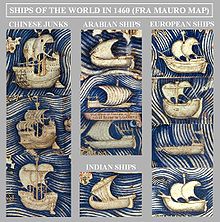
Ships of the world in 1460, according to the Fra Mauro map. Chinese
junks are described as very large, three or four-masted ships.
Niccolò da Conti in his relations of his travels in Asia between 1419 and 1444, matter-of-factly describes huge junks of about 2,000 tons:
They make ships larger than ours, about 2,000 tons
in size, with five sails and as many masts. The lower part is made of
three decks, so as to better resist storms, which occur frequently.
These ships are separated into several compartments, so that if one is
touched during a storm, the others remain intact.
Also, in 1456, the Fra Mauro map described the presence of junks in the Indian Ocean as well as their construction:
The ships called junks (lit. "Zonchi") that
navigate these seas carry four masts or more, some of which can be
raised or lowered, and have 40 to 60 cabins for the merchants and only
one tiller. They can navigate without a compass, because they have an astrologer, who stands on the side and, with an astrolabe in hand, gives orders to the navigator.
—(Text from the Fra Mauro map, 09-P25, [12]

Detail of the Fra Mauro Map relating the travels of a junk into the Atlantic Ocean in 1420. The ship also is illustrated above the text.
Fra Mauro further explains that one of these junks rounded the Cape of Good Hope and travelled far into the Atlantic Ocean, in 1420:
About the year of Our Lord 1420 a ship, what is called an Asian Junk (lit. "Zoncho de India"), on a crossing of the Sea of India towards the "Isle of Men and Women", was diverted beyond the "Cape of Diab" (Shown as the Cape of Good Hope on the map), through the "Green Isles" (lit. "isole uerde", Cabo Verde Islands), out into the "Sea of Darkness" ( Atlantic Ocean)
on a way west and southwest. Nothing but air and water was seen for 40
days and by their reckoning they ran 2,000 miles and fortune deserted
them. When the stress of the weather had subsided they made the return
to the said "Cape of Diab" in 70 days and drawing near to the shore to
supply their wants the sailors saw the egg of a bird called roc, which egg is as big as an amphora.
—Text from Fra Mauro map, 10-A13, [13]
[edit] Asian trade

A Chinese junk in Japan, at the beginning of the Sakoku period (1644-1648 Japanese woodblock print)
Chinese junks were used extensively in Asian trade during the 16th
and 17th century, especially to Southeast Asia and to Japan, where they
competed with Japanese Red Seal Ships, Portuguese carracks and Dutch galleons. Richard Cocks, the head of the English trading factory in Hirado, Japan, recorded that 50 to 60 Chinese junks visited Nagasaki in 1612 alone.
These junks were usually three masted, and averaging between 200 and
800 tons in size, the largest ones having around 130 sailors, 130
traders and sometimes hundreds of passengers.
[edit] 19th century junks (Qing Dynasty)

Junk Keying travelled from China to the United States and England between 1846 to 1848.
Large, ocean-going junks played a key role in Asian trade until the 19th century. One of these junks, Keying, sailed from China around the Cape of Good Hope
to the United States and England between 1846 and 1848. Many junks were
fitted out with carronades and other weapons for naval or piratical
uses. These vessels were typically called "war junks" or "armed junks"
by Western navies which began entering the region more frequently in the
18th century. The British, Americans and French fought several naval
battles with war junks in the 19th century, during the First Opium War, Second Opium War and in between.
[edit] 20th century junks
In 1938, E. Allen Petersen escaped the advancing Japanese armies by sailing a 36-foot (11 m) junk, Hummel Hummel, from Shanghai to California with his wife Tani and two White Russians (Czar loyalists). [14] In 1939, Richard Halliburton was lost at sea with his crew while sailing a specially constructed junk, Sea Dragon, from Hong Kong to the World Exposition in San Francisco.
In 1955, six young men sailed a Ming Dynasty-style junk from Taiwan to San Francisco. The four-month journey aboard the Free China
was captured on film and their arrival into San Francisco made
international front-page news. The five Chinese-born friends saw an
advertisement for an international trans-Atlantic yacht race, and jumped
at the opportunity for adventure. They were joined by the then US
Vice-Consul to China, who was tasked with capturing the journey on film.
Enduring typhoons and mishaps, the crew, having never sailed a
century-old junk before, learned along the way. The crew included Reno
Chen, Paul Chow, Loo-chi Hu, Benny Hsu, Calvin Mehlert and were led by
skipper Marco Chung. After a journey of 6,000 miles (9,700 km), the Free China
and her crew arrived into San Francisco Bay under a majestic fog on
August 8, 1955. Shortly afterward the footage was featured on ABC
television's Bold Journey travelogue. Hosted by John Stephenson
and narrated by ship's navigator Paul Chow, the program highlighted the
adventures and challenges of the junk's sailing across the Pacific, as
well as some humorous moments aboard ship. [15]
In 1959 a group of Catalan men, led by Jose Maria Tey, sailed from Hong Kong to Barcelona on a junk named Rubia. After their successful journey this junk was anchored as a tourist attraction at one end of Barcelona harbor, close to where La Rambla
meets the sea. Permanently moored along with it was an alleged
reproduction of Columbus' caravel "Santa Maria" during the 1960s and
part of the 1970s. [16]
In 1960 Lt. Col. Herbert George "Blondie" Hasler, ( Herbert Hasler), DSO, OBE, (27 February 1914 – 5 May 1987) sailed in the first Observer Single-handed Transatlantic Race ( OSTAR) from Plymouth to New York. His yacht was a modified Folkboat, called Jester, which at 25-foot (7.6 m) , was one of the smallest boats in the race.
The Jester relied on a junk rig
to reduce the physical effort of handling a conventional rig
single-handed. Safety was also increased as the junk rig enabled all
sail-handling to be completed from the safety of a central control
hatch. Hasler realised that he could sail Jester across the Atlantic without ever leaving the cabin. Hasler in Jester finished second, taking 48 days to cross the Atlantic.
In 1968, Bill King sailed a junk schooner in the controversial Sunday Times Golden Globe Race.

Traditional Malaysian Junk BILBO (1997)
In 1985, a Belgian Francis Clément ordered a 55 feet traditional
Malay Junk "Pinis" at Che Ali Bin Ngah (Chengal boat carpenter) on Pulau Duyong ( KT) Malaysia. In 1995 the boat ( BILBO)
was launched and finally reached Turkey in 1997 with the help of 5
Italian sailor teams. Today BILBO is anchored in the Setur Marina
Kusadasi Turkey. [17], [18]
A growing number of designs of modern recreational junk-rigged sailboats has emerged, such as Benford Design Group's Badger known from Annie Hill's book Voyaging on a Small Income. Tom MacNaughton of MacNaughton Group also has several popular junk rigged designs.
For long travels with few crew, the simplicity of the junk rig in
terms of construction, maintenance and handling makes it an important
alternative to more prevalent designs. Most notably the safety that
follows from extremely simple reefing, which is particularly important
with few crew and deteriorating conditions, minimizes the need to work
on deck while exposed to bad weather. Simple construction means lower
cost and simpler repairs.
[edit] See also
- ^ Junk, Online Etymology Dictionary.
- ^ http://www.friend.ly.net/users/dadadata/junk/platt/platt_chinese_sail.html "The masts, hull and standing rigging" section, paragraph 2, retrieved 13 Aug 09.
- ^ http://www.thomashoppe.net/Revival_of_the_Chinese_Junk "Materials and dimensions" section, paragraph 5, retrieved 13 Aug 09.
- ^ Konstam, Angus. 2007. Pirates: Predators of the Seas. 23-25
- ^ Needham, Volume 4, Part 3, 463.
- ^ Needham, Volume 4, Part 3, 469.
- ^ "Types of leeboards and daggerboards - see towards the bottom of the page". Puddle Duck Racer.
- ^ "Strange Things of the South", Wan Chen, from Robert Temple
- ^ When China Ruled the Seas, Louise Levathes, p.80
- ^ Sally
K. Church: The Colossal Ships of Zheng He: Image or Reality ?
(p.155-176) Zheng He; Images & Perceptions In: South China and
Maritime Asia , Volume 15, Hrsg: Ptak, Roderich /Höllmann Thomas, O.
Harrasowitz Verlag, Wiesbaden, (2005)
- ^ Niccolò da Conti, "Le Voyage aux Indes"
- ^ Fra
Mauro map, 09-P25, original Italian: "Le naue ouer çonchi che nauegano
questo mar portano quatro albori e, oltra de questi, do' che se può
meter e leuar et ha da 40 in 60 camerele per i marchadanti e portano uno
solo timon; le qual nauega sença bossolo, perché i portano uno
astrologo el qual sta in alto e separato e con l'astrolabio in man dà
ordene al nauegar" [1])
- ^ Text
from Fra Mauro map, 10-A13, original Italian: "Circa hi ani del Signor
1420 una naue ouer çoncho de india discorse per una trauersa per el mar
de india a la uia de le isole de hi homeni e de le done de fuora dal
cauo de diab e tra le isole uerde e le oscuritade a la uia de ponente e
de garbin per 40 çornade, non trouando mai altro che aiere e aqua, e per
suo arbitrio iscorse 2000 mia e declinata la fortuna i fece suo retorno
in çorni 70 fina al sopradito cauo de diab. E acostandose la naue a le
riue per suo bisogno, i marinari uedeno uno ouo de uno oselo nominato
chrocho, el qual ouo era de la grandeça de una bota d'anfora." [2]
- ^ "E. Allen Petersen Dies at 84; Fled Japanese on Boat in '38". The New York Times. 14 June 1987.
- ^ Charles W. Cushman Photograph Collection>> Results >> Details
- ^ Jose Maria Tey, Hong Kong to Barcelona in the Junk "Rubia", George G. Harrap & Co. Ltd, London 1962
- ^ http://www.mifasol.org/BILBO/Bilbo-Bibliography, BILBO Bibliography
- ^ http://forum.woodenboat.com/showthread.php?3071-Cengal,Malayan Chengal timber
[edit] References
[edit] External links
| [hide]
|
|
- Barca-longa
- Barque
- Barquentine
- Bermuda rig
- Bermuda sloop
- Bilander
- Brig
- Brigantine
- Caravel
- Carrack
- Catamaran
- Catboat
- Clipper
- Dutch clipper
- Cog
- Corvette
- Cutter
- Dhow
- Dinghy
- East Indiaman
- Falkuša
- Felucca
- Fifie
- Fluyt
- Fore-and-aft rig
- Frigate
- Full rigged pinnace
- Full rigged ship
- Fusta
- Gaff rig
- Galeas
- Galleon
- Galiot
- Gunter rig
- Hermaphrodite brig
- Herring buss
- Hoy
- Jackass-barque
- Jangada
- Junk
- Ketch
- Koch
- Longship
- Lugger
- Man-of-war
- Mast aft rig
- Masula
- Mersey Flat
- Multihull
- Nao
- Nordland
- Norfolk punt
- Norfolk wherry
- Patache
- Pausik
- Pilot cutter
- Pink
- Pinnace (ship's boat)
- Pocket cruiser
- Polacca
- Pram
- Proa
- Razee
- Sailing barge
- Sailing hydrofoil
- Scow
- Schooner
- Ship of the line
- Sixareen
- Sgoth
- Shitik
- Sloop
- Sloop-of-war
- Smack
- Snow
- Square rig
- Tall ship
- Thames sailing barge
- Trailer sailer
- Treasure ship
- Trimaran
- Uru
- Vinta
- Well smack
- Wherry
- Windjammer
- Windsurfer
- Xebec
- Yacht
- Yawl
- A junk is an ancient Chinese sailing vessel design still in use today. Junks were developed during the Han Dynasty
(206 BC–220 AD) and were used as sea-going vessels as early as the 2nd
century AD. They evolved in the later dynasties, and were used
throughout Asia for extensive ocean voyages. They were found, and in lesser numbers are still found, throughout South-East Asia and India, but primarily in China, perhaps most famously in Hong Kong. Found more broadly today is a growing number of modern recreational junk-rigged sailboats.
[edit] Etymology
The term ultimately stems from the Chinese chuán (船, "boat; ship"), also based on and pronounced as [dzuːŋ] (Pe̍h-ōe-jī: chûn) in the Min Nan dialect (閩南語), or zhōu 舟, the old word for a sailing vessel.[citation needed] It entered the English language in the 17th century through the Portuguese junco from the Javanese djong.[1] The modern Standard Chinese word for an ocean-going vessel is cáo (艚).
[edit] Design
Junks were efficient and sturdy ships
that sailed long distances as early as the 2nd century AD. They
incorporated numerous technical advances in sail plan and hull designs
that were later adopted in Western shipbuilding.
The historian H. Warington Smyth considered the junk one of the most
efficient ship designs, stating that "As an engine for carrying man and
his commerce upon the high and stormy seas as well as on the vast inland
waterways, it is doubtful if any class of vessel… is more suited or
better adapted to its purpose than the Chinese or Indian junk, and it is
certain that for flatness of sail and handiness, the Chinese rig is
unsurpassed."
[edit] Sail plan
A two-masted Chinese junk, from the Tiangong Kaiwu of Song Yingxing, published in 1637.
The structure and flexibility of junk sails make the junk easy to sail, and fast. Unlike a traditional square rigged ship, the sails of a junk can be moved inward, toward the long axis of the ship, allowing the junk to sail into the wind.
The sails include several horizontal members, called "battens",
which provide shape and strength. Junk sails are controlled at their
trailing edge by lines much in the same way as the mainsail on a typical
sailboat, but in the junk sail each batten has a line attached to its
trailing edge where on a typical sailboat a single line (the sheet) is
attached only to the boom. The sails can also be easily reefed and
adjusted for fullness, to accommodate various wind strengths. The
battens also make the sails more resistant than traditional sails to
large tears, as a tear is typically limited to a single "panel" between
battens. Junk sails have much in common with the most aerodynamically
efficient sails used today in windsurfers or catamarans.
The standing rigging is simple or absent.
The sail-plan
is also spread out between multiple masts, allowing for a powerful sail
surface, and a good repartition of efforts. The rig allows for good
sailing into the wind.
The Kangxi Emperor (r. 1654–1722) on a tour, seated prominently on the deck of a junk ship.
Flags were hung from the masts to bring good luck and women to the
sailors. A legend among the Chinese during the junk's heyday regarded a
dragon which lived in the clouds. It was said that when the dragon
became angry, it created typhoons and storms. Bright flags, with Chinese
writing on them, were said to please the dragon. Red was best, as it
would induce the dragon to help the sailors.
[edit] Hull design
Classic junks were built of softwoods (although of teak in Guangdong)
with multiple compartments accessed by separate hatches and ladders,
reminiscent of the interior structure of bamboo. Traditionally, the hull
has a horseshoe-shaped stern supporting a high poop deck. The bottom is flat with no keel (similar to a sampan), so that the boat relies on a daggerboard,[2] leeboard or very large rudder to prevent the boat from slipping sideways in the water.[3] The largest junks, the treasure ships commanded by Zheng He,
were built for world exploration in the 15th century, and according to
some interpretations may have been over 120 metres (390 ft) in length.
[edit] Rudders
Junks employed stern-mounted rudders centuries before their adoption
in the West, though the rudder's origin, form and construction was
completely different. It was an innovation which permitted the steering
of large, high-freeboard
ships, and, due to its well-balanced design, allowed adjustment
according to the depth of the water. A sizable junk can have a rudder
that needs up to three members of the crew to control in strong weather.
The world's oldest known depiction of a stern-mounted rudder can be
seen on a pottery model of a junk dating from before 1st century AD,[4]
though some scholars think this may be a steering oar - a possible
interpretation given that the model is of a river boat that was probably
towed or poled.
From sometime in the 13th-15th centuries, many junks began
incorporating "fenestrated" rudders (rudders with holes in them),
probably adopted to lessen the force needed to direct the steering of
the rudder.
The rudder is reported to be the strongest part of the junk. In the Tiangong Kaiwu "Exploitation of the Works of Nature" (1637), Song Yingxing wrote, "The rudder-post is made of elm, or else of langmu or of zhumu." The Ming author also applauds the strength of the langmu wood as "if one could use a single silk thread to hoist a thousand jun or sustain the weight of a mountain landslide."
[edit] Separate compartments
Another characteristic of junks, interior compartments or bulkheads, strengthened the ship and slowed flooding in case of holing. Ships built in this manner were written of in Zhu Yu's book Pingzhou Table Talks, published by 1119 AD during the Song Dynasty.[5] Again, this type of construction for Chinese ship hulls was attested to by the Moroccan Muslim Berber traveler Ibn Batutta (1304-1377 AD), who described it in great detail (refer to Technology of the Song Dynasty).[6] Although some historians have questioned whether the compartments were watertight, most believe that watertight compartments did exist in Chinese junks. All wrecks discovered so far have limber holes;
these are different from the free flooding holes that are located only
in the foremost and aftermost compartments, but are at the base of the
transverse bulkheads allowing water in each compartment to drain to the
lowest compartment, thus facilitating pumping. It is believed from
evidence in wrecks that the limber holes could be stopped either to
allow the carriage of liquid cargoes or to isolate a compartment that
had sprung a leak.
Benjamin Franklin wrote in a 1787 letter on the project of mail packets between the United States and France:
As these vessels are not to be laden with goods,
their holds may without inconvenience be divided into separate
apartments, after the Chinese manner, and each of these apartments
caulked tight so as to keep out water.
In 1795, Sir Samuel Bentham, inspector of dockyards of the Royal Navy,
and designer of six new sailing ships, argued for the adoption of
"partitions contributing to strength, and securing the ship against
foundering, as practiced by the Chinese of the present day". His idea
was not adopted. Bentham had been in China in 1782, and he acknowledged
that he had got the idea of watertight compartments by looking at
Chinese junks there. Bentham was a friend of Isambard Brunel,
so it is possible that he had some influence on Brunel's adoption of
longitudinal, strengthening bulkheads in the lower deck of the SS Great Britain.
Bentham had already by this time designed and had built a segmented
barge for use on the Volga River, so the idea of transverse hull
separation was evidently in his mind. Perhaps more to the point, there
is a very large difference between the transverse bulkheads in Chinese
construction, which offer no longitudinal strengthening, and the
longitudinal members which Brunel adopted, almost certainly inspired by
the bridge engineering in which he and his contemporaries in iron
shipbuilding innovation were most versed.
Due to the numerous foreign primary sources that hint to the
existence of true watertight compartments in junks, historians such as Joseph Needham
proposed that the limber holes were stopped up as noted above in case
of leakage. He addresses the quite separate issue of free-flooding
compartments on pg 422 of Science and Civilisation in Ancient China:
Less well known is the interesting fact that in
some types of Chinese craft the foremost(and less frequently also the
aftermost) compartments is made free-flooding. Holes are purposely
contrived in the planking. This is the case with the salt-boats which
shoot the rapdown from Tzuliuching in Szechuan, the gondola-shaped boats
of the Poyang Lake, and many sea going junks. The Szechuanese boatmen
say that this reduces resistance to the water to a minimum, and the
device must certainly cushion the shocks of pounding when the boat
pitches heavily in the rapids, for she acquires and discharges water
ballast rapidly just at the time when it is most desirable to counteract
buffeting at stem and stern. The sailors say that it stops junks flying
up into the wind. It may be the reality at the bottom of the following
story, related by Liu Ching-Shu of the +5th century, in his book I Yuan (Garden of Strange Things)
In Fu-Nan (Cambodia) gold is always used in transactions. Once there
were (some people who) having hired a boat to go from east to west near
and far, had not reached their destination when the time came for the
payment of the pound (of gold) which had been agreed upon. They
therefore wished to reduce the quantity (to be paid). The master of the
ship then played a trick upon them. He made (as it were) a way for the
water to enter the bottom of the boat, which seemed to be about to sink,
and remained stationary, moving neither forward nor backward. All the
passengers were very frightened and came to make offerings. The boat
(afterwards) returned to its original state.
This, however, would seem to have involved openings which could be
controlled, and the water pumped out afterwards. This was easily
effected in China (still seen in Kuangtung and Hong Kong), but the
practice was also known in England, where the compartment was called the
'wet-well', and the boat in which it was built, a 'well-smack'. If the
tradition is right that such boats date in Europe from +1712 then it may
well be that the Chinese bulkhead principle was introduced twice, first
for small coastal fishing boats at the end of the seventeenth century,
and then for large ships a century later. However, the wet well is
probably a case of parallel invention since its manner of construction
is quite different from that of Chinese junks, the wet well quite often
not running the full width of the boat, but only occupying the central
part of the hull either side of the keel.
[edit] Leeboards and centerboards
Leeboards and centerboards,
used to stabilize the junk and to improve its capability to sail
upwind, are documented from a 759 AD book by Li Chuan. The innovation
was adopted by Portuguese and Dutch ships around 1570.[citation needed]
Junks often employ a daggerboard that is forward on the hull which
allows the center section of the hull to be free of the daggerboard
trunk allowing larger cargo compartments. [7] Because the daggerboard is located so far forward, the junk must use a balanced rudder to counteract the imbalance of lateral resistance.
Other innovations included the square-pallet bilge pump,
which was adopted by the West during the 16th century for work ashore,
the western chain pump, which was adopted for shipboard use, being of a
different derivation. Junks also relied on the compass
for navigational purposes. However, as with almost all vessels of any
culture before the late 19th century, the accuracy of magnetic compasses
aboard ship, whether from a failure to understand deviation (the
magnetism of the ship's iron fastenings) or poor design of the compass
card (the standard drypoint compasses were extremely unstable), meant
that they did little to contribute to the accuracy of navigation by dead
reckoning.[citation needed]
[edit] History
The first records of junks can be found in references dating to the Han Dynasty (220 BC-200 AD).
[edit] 2nd century junks (Han Dynasty)
The 3rd century book "Strange Things of the South" (南州異物志) by
Wan Chen (萬震) describes junks capable of carrying 700 people together
with 260 tons of cargo ("more than 10,000 "斛"). He explains the ship's
design as follows:
The four sails do not face directly forward, but
are set obliquely, and so arranged that they can all be fixed in the
same direction, to receive the wind and to spill it. Those sails which
are behind the most windward one receiving the pressure of the wind,
throw it from one to the other, so that they all profit from its force.
If it is violent, (the sailors) diminish or augment the surface of the
sails according to the conditions. This oblique rig, which permits the
sails to receive from one another the breath of the wind, obviates the
anxiety attendant upon having high masts. Thus these ships sail without
avoiding strong winds and dashing waves, by the aid of which they can
make great speed
A 260 AD book by Kang Tai (康泰) also described ships with seven masts, traveling as far as Syria.
[edit] 10–13th century junks (Song Dynasty)
The great trading dynasty of the Song
employed junks extensively. The naval strength of the Song, both
mercantile and military, became the backbone of the naval power of the
following Yuan dynasty. In particular the Mongol invasions of Japan (1274–84), as well as the Mongol invasion of Java, essentially relied on recently acquired Song naval capabilities.
[edit] 14th century junks (Yuan Dynasty)
The enormous dimensions of the Chinese ships of the Medieval period
are described in Chinese sources, and are confirmed by Western travelers
to the East, such as Marco Polo, Ibn Battuta and Niccolò da Conti. According to Ibn Battuta, who visited China in 1347:
…We stopped in the port of Calicut, in which there were at the time thirteen Chinese vessels, and disembarked. On the China Sea
traveling is done in Chinese ships only, so we shall describe their
arrangements. The Chinese vessels are of three kinds; large ships called
chunks (junks), middle sized ones called zaws (dhows) and the small ones kakams. The large ships have anything from twelve down to three sails, which are made of bamboo
rods plaited into mats. They are never lowered, but turned according to
the direction of the wind; at anchor they are left floating in the
wind.
A ship carries a complement of a thousand men, six hundred of whom
are sailors and four hundred men-at-arms, including archers, men with
shields and crossbows, who throw naphtha.
Three smaller ones, the "half", the "third" and the "quarter",
accompany each large vessel. These vessels are built in the towns of
Zaytun (a.k.a Zaitun ; today's Quanzhou; 刺桐)
and Sin-Kalan. The vessel has four decks and contains rooms, cabins,
and saloons for merchants; a cabin has chambers and a lavatory, and can
be locked by its occupants.
This is the manner after which they are made; two (parallel) walls of very thick wooden (planking) are raised and across the space between them are placed very thick planks (the bulkheads)
secured longitudinally and transversely by means of large nails, each
three ells in length. When these walls have thus been built the lower
deck is fitted in and the ship is launched before the upper works are
finished.
[edit] 15–17th century junks (Ming Dynasty)
[edit] Expedition of Zheng He
Early 17th century Chinese woodblock print, thought to represent Zheng He's ships
The largest junks ever built were possibly those of Admiral Zheng He, for his expeditions in the Indian Ocean.
According to Chinese sources, the fleet for Zheng's 1405 expedition
comprised nearly 30,000 sailors and over 300 ships at its height.[citation needed]
The dimensions of Zheng He's ships according to ancient Chinese chronicles are disputed by modern scholars (see below):
- Treasure ships,
used by the commander of the fleet and his deputies (Nine-masted junks,
claimed by the Ming Shi to be about 420 feet long and 180 feet wide).
- Horse ships, carrying tribute goods and repair material for the fleet (Eight-masted junks, about 340 feet long and 140 feet wide)
- Supply ships, containing food-staple for the crew (Seven-masted junks, about 260 feet long and 115 feet wide).
- Troop transports (Six-masted junks, about 220 feet long and 83 feet wide).
- Fuchuan warships (Five-masted junks, about 165 feet long).
- Patrol boats (Eight-oared, about 120 feet long).
- Water tankers, with 1 month's supply of fresh water.
Some recent research suggests that the actual length of the biggest
treasure ships may have been between 390–408 feet (119–124 m) long and
160–166 feet (49–51 m) wide, [9] while others estimate them to be 200–250 feet (61–76 m) in length. [10]
[edit] Conquest of Taiwan
In 1661, a naval fleet of 400 junks and 25,000 men led by the Ming loyalist Zheng Chenggong (Cheng Ch'eng-kung in Wade-Giles, known in the West as Koxinga), arrived in Taiwan to oust the Dutch from Zeelandia. Following a nine month siege, Cheng captured the Dutch fortress Fort Zeelandia. A peace treaty between Koxinga and the Dutch Government was signed at Castle Zeelandia on February 1st 1662, and Taiwan became Koxinga's base for the Kingdom of Tungning.
[edit] Accounts of medieval travellers
Ships of the world in 1460, according to the Fra Mauro map. Chinese
junks are described as very large, three or four-masted ships.
Niccolò da Conti in his relations of his travels in Asia between 1419 and 1444, matter-of-factly describes huge junks of about 2,000 tons:
They make ships larger than ours, about 2,000 tons
in size, with five sails and as many masts. The lower part is made of
three decks, so as to better resist storms, which occur frequently.
These ships are separated into several compartments, so that if one is
touched during a storm, the others remain intact.
Also, in 1456, the Fra Mauro map described the presence of junks in the Indian Ocean as well as their construction:
The ships called junks (lit. "Zonchi") that
navigate these seas carry four masts or more, some of which can be
raised or lowered, and have 40 to 60 cabins for the merchants and only
one tiller. They can navigate without a compass, because they have an astrologer, who stands on the side and, with an astrolabe in hand, gives orders to the navigator.
—(Text from the Fra Mauro map, 09-P25, [12]
Detail of the Fra Mauro Map relating the travels of a junk into the Atlantic Ocean in 1420. The ship also is illustrated above the text.
Fra Mauro further explains that one of these junks rounded the Cape of Good Hope and travelled far into the Atlantic Ocean, in 1420:
About the year of Our Lord 1420 a ship, what is called an Asian Junk (lit. "Zoncho de India"), on a crossing of the Sea of India towards the "Isle of Men and Women", was diverted beyond the "Cape of Diab" (Shown as the Cape of Good Hope on the map), through the "Green Isles" (lit. "isole uerde", Cabo Verde Islands), out into the "Sea of Darkness" ( Atlantic Ocean)
on a way west and southwest. Nothing but air and water was seen for 40
days and by their reckoning they ran 2,000 miles and fortune deserted
them. When the stress of the weather had subsided they made the return
to the said "Cape of Diab" in 70 days and drawing near to the shore to
supply their wants the sailors saw the egg of a bird called roc, which egg is as big as an amphora.
—Text from Fra Mauro map, 10-A13, [13]
[edit] Asian trade
A Chinese junk in Japan, at the beginning of the Sakoku period (1644-1648 Japanese woodblock print)
Chinese junks were used extensively in Asian trade during the 16th
and 17th century, especially to Southeast Asia and to Japan, where they
competed with Japanese Red Seal Ships, Portuguese carracks and Dutch galleons. Richard Cocks, the head of the English trading factory in Hirado, Japan, recorded that 50 to 60 Chinese junks visited Nagasaki in 1612 alone.
These junks were usually three masted, and averaging between 200 and
800 tons in size, the largest ones having around 130 sailors, 130
traders and sometimes hundreds of passengers.
[edit] 19th century junks (Qing Dynasty)
Junk Keying travelled from China to the United States and England between 1846 to 1848.
Large, ocean-going junks played a key role in Asian trade until the 19th century. One of these junks, Keying, sailed from China around the Cape of Good Hope
to the United States and England between 1846 and 1848. Many junks were
fitted out with carronades and other weapons for naval or piratical
uses. These vessels were typically called "war junks" or "armed junks"
by Western navies which began entering the region more frequently in the
18th century. The British, Americans and French fought several naval
battles with war junks in the 19th century, during the First Opium War, Second Opium War and in between.
[edit] 20th century junks
In 1938, E. Allen Petersen escaped the advancing Japanese armies by sailing a 36-foot (11 m) junk, Hummel Hummel, from Shanghai to California with his wife Tani and two White Russians (Czar loyalists). [14] In 1939, Richard Halliburton was lost at sea with his crew while sailing a specially constructed junk, Sea Dragon, from Hong Kong to the World Exposition in San Francisco.
In 1955, six young men sailed a Ming Dynasty-style junk from Taiwan to San Francisco. The four-month journey aboard the Free China
was captured on film and their arrival into San Francisco made
international front-page news. The five Chinese-born friends saw an
advertisement for an international trans-Atlantic yacht race, and jumped
at the opportunity for adventure. They were joined by the then US
Vice-Consul to China, who was tasked with capturing the journey on film.
Enduring typhoons and mishaps, the crew, having never sailed a
century-old junk before, learned along the way. The crew included Reno
Chen, Paul Chow, Loo-chi Hu, Benny Hsu, Calvin Mehlert and were led by
skipper Marco Chung. After a journey of 6,000 miles (9,700 km), the Free China
and her crew arrived into San Francisco Bay under a majestic fog on
August 8, 1955. Shortly afterward the footage was featured on ABC
television's Bold Journey travelogue. Hosted by John Stephenson
and narrated by ship's navigator Paul Chow, the program highlighted the
adventures and challenges of the junk's sailing across the Pacific, as
well as some humorous moments aboard ship. [15]
In 1959 a group of Catalan men, led by Jose Maria Tey, sailed from Hong Kong to Barcelona on a junk named Rubia. After their successful journey this junk was anchored as a tourist attraction at one end of Barcelona harbor, close to where La Rambla
meets the sea. Permanently moored along with it was an alleged
reproduction of Columbus' caravel "Santa Maria" during the 1960s and
part of the 1970s. [16]
In 1960 Lt. Col. Herbert George "Blondie" Hasler, ( Herbert Hasler), DSO, OBE, (27 February 1914 – 5 May 1987) sailed in the first Observer Single-handed Transatlantic Race ( OSTAR) from Plymouth to New York. His yacht was a modified Folkboat, called Jester, which at 25-foot (7.6 m) , was one of the smallest boats in the race.
The Jester relied on a junk rig
to reduce the physical effort of handling a conventional rig
single-handed. Safety was also increased as the junk rig enabled all
sail-handling to be completed from the safety of a central control
hatch. Hasler realised that he could sail Jester across the Atlantic without ever leaving the cabin. Hasler in Jester finished second, taking 48 days to cross the Atlantic.
In 1968, Bill King sailed a junk schooner in the controversial Sunday Times Golden Globe Race.
Traditional Malaysian Junk BILBO (1997)
In 1985, a Belgian Francis Clément ordered a 55 feet traditional
Malay Junk "Pinis" at Che Ali Bin Ngah (Chengal boat carpenter) on Pulau Duyong ( KT) Malaysia. In 1995 the boat ( BILBO)
was launched and finally reached Turkey in 1997 with the help of 5
Italian sailor teams. Today BILBO is anchored in the Setur Marina
Kusadasi Turkey. [17], [18]
A growing number of designs of modern recreational junk-rigged sailboats has emerged, such as Benford Design Group's Badger known from Annie Hill's book Voyaging on a Small Income. Tom MacNaughton of MacNaughton Group also has several popular junk rigged designs.
For long travels with few crew, the simplicity of the junk rig in
terms of construction, maintenance and handling makes it an important
alternative to more prevalent designs. Most notably the safety that
follows from extremely simple reefing, which is particularly important
with few crew and deteriorating conditions, minimizes the need to work
on deck while exposed to bad weather. Simple construction means lower
cost and simpler repairs.
[edit] See also
- ^ Junk, Online Etymology Dictionary.
- ^ http://www.friend.ly.net/users/dadadata/junk/platt/platt_chinese_sail.html "The masts, hull and standing rigging" section, paragraph 2, retrieved 13 Aug 09.
- ^ http://www.thomashoppe.net/Revival_of_the_Chinese_Junk "Materials and dimensions" section, paragraph 5, retrieved 13 Aug 09.
- ^ Konstam, Angus. 2007. Pirates: Predators of the Seas. 23-25
- ^ Needham, Volume 4, Part 3, 463.
- ^ Needham, Volume 4, Part 3, 469.
- ^ "Types of leeboards and daggerboards - see towards the bottom of the page". Puddle Duck Racer.
- ^ "Strange Things of the South", Wan Chen, from Robert Temple
- ^ When China Ruled the Seas, Louise Levathes, p.80
- ^ Sally
K. Church: The Colossal Ships of Zheng He: Image or Reality ?
(p.155-176) Zheng He; Images & Perceptions In: South China and
Maritime Asia , Volume 15, Hrsg: Ptak, Roderich /Höllmann Thomas, O.
Harrasowitz Verlag, Wiesbaden, (2005)
- ^ Niccolò da Conti, "Le Voyage aux Indes"
- ^ Fra
Mauro map, 09-P25, original Italian: "Le naue ouer çonchi che nauegano
questo mar portano quatro albori e, oltra de questi, do' che se può
meter e leuar et ha da 40 in 60 camerele per i marchadanti e portano uno
solo timon; le qual nauega sença bossolo, perché i portano uno
astrologo el qual sta in alto e separato e con l'astrolabio in man dà
ordene al nauegar" [1])
- ^ Text
from Fra Mauro map, 10-A13, original Italian: "Circa hi ani del Signor
1420 una naue ouer çoncho de india discorse per una trauersa per el mar
de india a la uia de le isole de hi homeni e de le done de fuora dal
cauo de diab e tra le isole uerde e le oscuritade a la uia de ponente e
de garbin per 40 çornade, non trouando mai altro che aiere e aqua, e per
suo arbitrio iscorse 2000 mia e declinata la fortuna i fece suo retorno
in çorni 70 fina al sopradito cauo de diab. E acostandose la naue a le
riue per suo bisogno, i marinari uedeno uno ouo de uno oselo nominato
chrocho, el qual ouo era de la grandeça de una bota d'anfora." [2]
- ^ "E. Allen Petersen Dies at 84; Fled Japanese on Boat in '38". The New York Times. 14 June 1987.
- ^ Charles W. Cushman Photograph Collection>> Results >> Details
- ^ Jose Maria Tey, Hong Kong to Barcelona in the Junk "Rubia", George G. Harrap & Co. Ltd, London 1962
- ^ http://www.mifasol.org/BILBO/Bilbo-Bibliography, BILBO Bibliography
- ^ http://forum.woodenboat.com/showthread.php?3071-Cengal,Malayan Chengal timber
[edit] References
[edit] External links
|
|
|


Tidak ada komentar:
Posting Komentar